Brewing Enzymes Efficiency: Faster Wort Separation and Better Extract in Production Brewing
This guide shows where brewhouse efficiency is lost in adjunct and high-glucan mashes. It explains which enzyme blends address it. It lists what bulk buyers should check before choosing a supplier. Compare brewing enzymes for efficiency: enzyme types, process fit, dosage, QC, COA/TDS/SDS, pilot trials, and cost-in-use for industrial buyers.
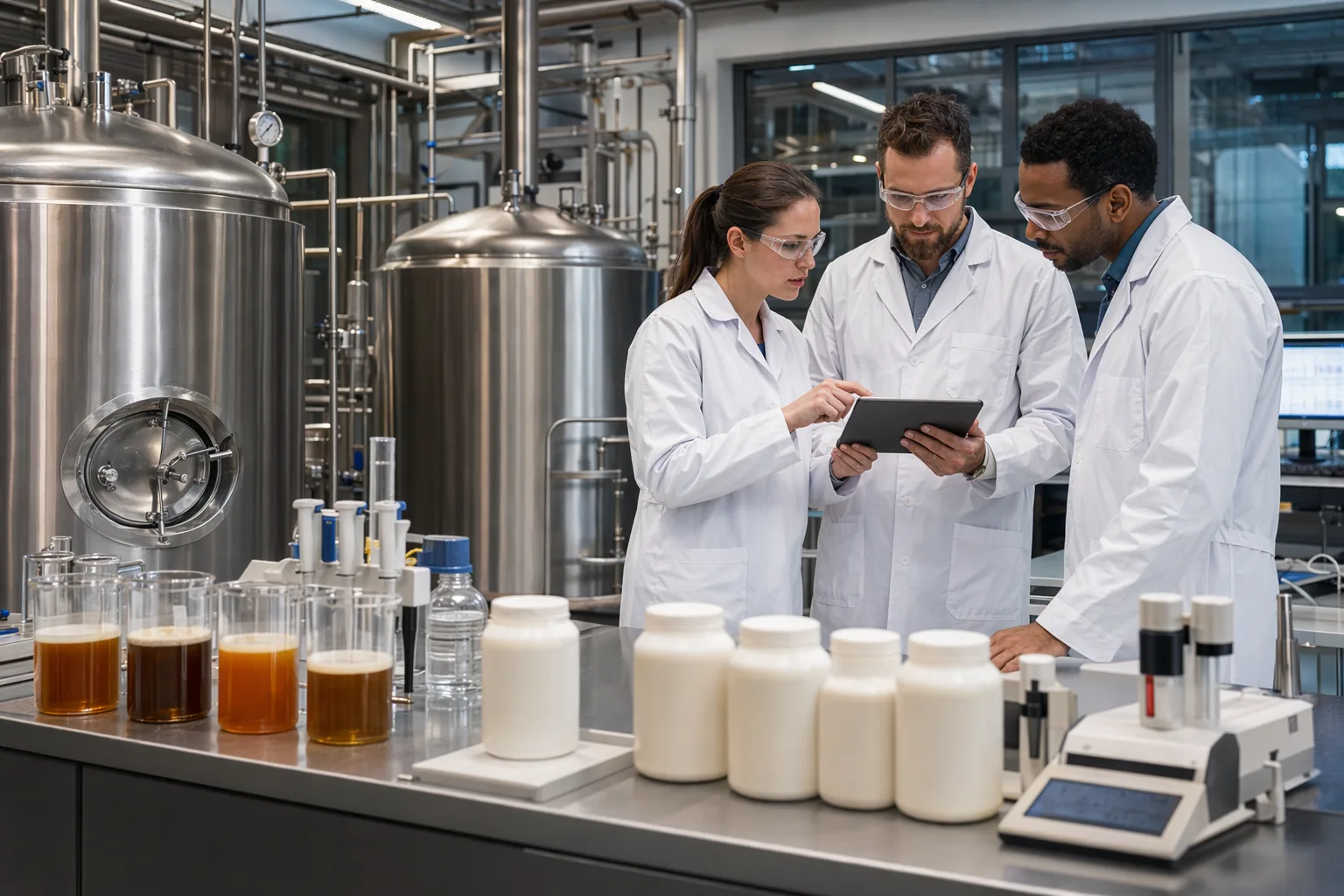
ClearEnzyme supplies brewing enzymes in bulk to breweries, beverage manufacturers, distributors and formulators who buy for production. For a brewhouse, enzyme efficiency shows up in a few plain numbers: how fast the wort runs off, how much extract each batch of grist gives, and how consistently each batch ferments.
This guide covers where that efficiency is usually lost (thick, slow-running mashes when adjuncts or gum-rich grain are used), which enzyme combinations address it, and what to check before choosing a supplier. Supply is liquid or powder in 25 kg drums or 200 L barrels, minimum order 25 kg, quoted per order. To request a quote, send the product or application, the quantity and the destination through the inquiry form.
Why Brewing Enzymes Efficiency Matters in Procurement
For a commercial brewery, brewing enzymes efficiency is not only a technical question; it is a purchasing, capacity, and quality decision. Efficient enzyme selection can support more consistent mash conversion, faster lautering, improved filterability, controlled attenuation, and better use of adjuncts such as corn, rice, sorghum, or unmalted barley. In the brewing enzymes market, many products appear similar on a label, but their usable value depends on activity standardization, process fit, stability, and supplier documentation. A low unit price can become expensive if the enzyme requires high dosage, narrow operating conditions, or frequent process adjustment. Industrial buyers should compare enzyme performance against defined production targets rather than broad claims. For example, the role of enzymes in brewing process control may be measured through extract recovery, wort viscosity, fermentability, haze stability, and cycle time. A structured checklist helps technical, procurement, and quality teams evaluate products consistently before full-scale adoption.
Define the primary process bottleneck before requesting samples. • Compare cost per hectoliter or barrel, not only container price. • Require technical documentation before pilot validation.
Where Brewhouse Efficiency Is Lost: Thick Mash and Slow Wort Separation
Many lager brewers replace part of the malt with rice, corn or starch to lower raw-material cost and lighten the beer. Malt brings its own starch-splitting enzymes; rice and corn bring none, so in a heavy-adjunct mash the brewhouse has to supply that activity from outside. Such mashes are thick and slow to run off, with gum-like material holding back wort separation and leaving the wort cloudy.
The underlying cause is the same in all-malt brewing with poorly modified malt: when β-glucans and xylans (pentosans) are only partly broken down during saccharification, they stay in the mash liquor and keep it viscous. High viscosity slows mash filtration, and mash filtration is the step that sets how quickly a brewhouse can move a batch on to the kettle and fermenter. Bringing viscosity down shortens that step and lets more extract run off with the wort.
Typical symptoms: long lauter or mash-filter cycles. • Cloudy first wort. • Extract left behind in the spent grain. • Run-off that changes from batch to batch when the grain lot changes.
The Enzyme Combination for Viscous Mashes
Suppliers serving production breweries offer compound "brewing enzyme" blends made for the saccharification stage that combine three activities:
β-glucanase: an endo-acting enzyme that cuts β-1,3 and β-1,4 glucosidic bonds in barley β-glucan, the main cause of gummy, slow-running wort. • Xylanase: cuts the β-1,4 xylosidic bonds in pentosans, xylans and arabinoxylans; used together with β-glucanase, it breaks down the rest of the viscous material. • Neutral protease: works during the protein rest, improves the protein profile of the wort and raises free amino nitrogen (FAN), which feeds the yeast.
The glucanase and xylanase in such blends are selected to keep working through the hotter saccharification rests rather than only at the protein rest, so they act while the mash is being converted. Ask any supplier to state the working temperature range on the TDS and confirm it against your own mash schedule.
How Supply Has Changed, and What to Ask a Supplier
Brewing enzyme supply has moved through three stages: single enzymes (an amylase on its own), then pre-mixed compound blends that solve several problems in one addition, and now programs adjusted to a brand and to each season's malt quality. The suppliers that hold production accounts do it through application support: when malt arrives damp or the adjunct source changes, the blend is adjusted. Enzymes are a very small share of the cost of a finished beer, but almost every industrial brew uses them, so reliability matters more than the unit price.
When blending became a pure price contest, some sellers cut activity stability to cut cost. For a buyer, that means:
Check activity lot by lot on the certificate of analysis, not only on the first sample. • Ask whether the supplier ferments its enzymes or blends bought-in ones, and who adjusts the formula when your raw materials change. • Judge a product by whether it fixes your bottleneck (a blocked filter, a slow run-off), not by laboratory figures alone.
Demand is also widening. Craft breweries rarely fight adjunct viscosity, but they need clarification, foam stability and flavour support, such as proteases against chill haze. Low-calorie and dry beers use pullulanase and glucoamylase to break down residual dextrins so the yeast can ferment them out.
Enzyme Types Commonly Used in Brewing Industry Applications
The enzymes used in brewing industry operations are selected according to raw material, mash program, yeast target, and finished beer specification. Alpha-amylase supports starch liquefaction by reducing mash viscosity and producing dextrins; working temperature and pH depend on the source and formulation and are stated on the TDS. Glucoamylase brewing applications convert dextrins to fermentable glucose for high-attenuation, low-carbohydrate, dry beer or distilling mashes. Beta-glucanase improves wort separation and filtration by reducing beta-glucans from barley or adjuncts, while proteases can support FAN development and modification when malt quality varies. Beer clarification enzyme products, including protease-based or haze-reduction systems, may be used post-fermentation depending on beer style and process design. Winemaking enzymes overlap in clarification and extraction functions, but brewery buyers should confirm suitability for beer matrix, dosage timing, and regulatory use.
Alpha-amylase: liquefaction and viscosity reduction. • Glucoamylase: higher fermentability and attenuation. • Beta-glucanase: lautering and filtration support. • Protease: protein modification or haze management. • Pectinase: more common in winemaking than standard brewing.
Process Conditions to Compare Before Scale-Up
Brewing enzymes are process tools, so their efficiency depends on matching activity to real brewery conditions. Buyers should ask suppliers for recommended pH range, temperature range, contact time, point of addition, inactivation guidance, and compatibility with calcium, sulfite, cleaning residues, or filtration aids. Normal mash pH suits many brewing enzyme systems, but specialty enzymes may prefer lower or higher ranges. Temperature tolerance also varies: some amylases are designed for high-temperature liquefaction, while fungal glucoamylase or beta-glucanase products may lose activity if added too hot. Dosage bands are usually expressed as grams, milliliters, or activity units per ton of grist, hectoliter of mash, or barrel of wort. Practical screening ranges often start at supplier-recommended low, target, and high rates, then narrow through pilot data. Avoid assuming that a dosage from an enzymes in brewing pdf or generic technical article will transfer directly to a specific brewhouse.
Confirm where the enzyme is added: mash-in, cereal cooker, fermenter, maturation, or pre-filtration. • Record actual pH and temperature, not only recipe targets. • Test low, medium, and high dosage levels during pilot trials.
Documentation: COA, TDS, SDS, and Supplier Qualification
A qualified supplier should provide a current Technical Data Sheet, Safety Data Sheet, and Certificate of Analysis for each commercial batch. The TDS should describe enzyme function, activity unit definition, carrier or diluent information where applicable, recommended dosage, storage conditions, shelf life, and safe handling guidance. The SDS supports occupational safety review, including dust, aerosol, skin, eye, and respiratory exposure controls. The COA should show batch identification and relevant QC results, such as activity, appearance, microbiological limits when specified, and conformity to the supplier’s release specification. For B2B procurement, supplier qualification should also consider change notification practices, traceability, packaging integrity, lead time, technical support, and ability to support pilot validation. Do not rely only on broad statements about the role of enzymes in brewing industry productivity. Ask for documents that let your quality, EHS, and production teams assess risk before the enzyme enters your plant.
Request COA for the specific lot supplied, not only a sample document. • Check storage temperature and shelf-life requirements. • Confirm traceability and change notification expectations.
Pilot Validation and Cost-in-Use Comparison
Pilot validation is the safest way to compare brewing enzymes efficiency across suppliers. Design the trial around one measurable objective, such as higher extract, shorter mash separation, reduced filtration pressure, controlled final gravity, or improved colloidal stability. Keep grist, water profile, mash schedule, yeast, fermentation temperature, and filtration settings as consistent as possible. Useful QC checks include extract yield, iodine conversion, wort viscosity, beta-glucan level, FAN, apparent attenuation, real extract, ABV, turbidity, filter run length, foam, haze stability, and sensory review. Cost-in-use should include enzyme dosage, activity concentration, freight, storage losses, process time saved, beer recovery, reject reduction, and any impact on downstream clarification or filtration aids. In the US brewing enzymes market and other regional markets, the best purchasing decision is rarely the cheapest drum. It is the enzyme system that meets specification reliably, simplifies production, and is supported by responsive technical documentation.
Run a control batch alongside enzyme trial batches where possible. • Calculate cost per finished hectoliter, barrel, or packaged unit. • Include quality and yield effects in the business case.
Technical Buying Checklist
Buyer Questions
Start with the process objective, then compare enzyme activity, unit definition, dosage range, pH and temperature window, storage stability, and documentation quality. Request TDS, SDS, and lot-specific COA. Run pilot brews using the same grist, mash schedule, yeast, and filtration settings. Evaluate extract yield, fermentability, viscosity, filtration rate, haze, sensory profile, and cost per finished barrel or hectoliter.
Enzymes help convert starch, reduce viscosity, improve wort separation, adjust fermentability, support protein modification, and manage haze depending on enzyme type. In practical brewery operations, their value is measured by stable conversion, higher extract recovery, predictable final gravity, shorter filtration time, and fewer quality deviations. Efficiency should be confirmed by QC data and production trials rather than supplier claims alone.
Glucoamylase dosage depends on activity concentration, substrate, target attenuation, contact time, and temperature. Suppliers typically provide a starting range by grist weight, wort volume, or fermenter volume. For trials, test a low, target, and high dosage under controlled conditions around the recommended pH and temperature. Track fermentable sugars, apparent attenuation, final gravity, ABV, flavor impact, and residual enzyme risk.
Sometimes they can reduce filtration load, but they should not be assumed to replace filtration aids without validation. Beer clarification enzyme performance depends on beer style, protein and polyphenol profile, maturation time, temperature, and filtration system. Pilot or side-stream trials should measure turbidity, haze stability, filter differential pressure, run length, beer recovery, foam, and sensory results before changing the full production process.
A practical supplier pack should include the Technical Data Sheet, Safety Data Sheet, sample Certificate of Analysis, handling instructions, storage and shelf-life guidance, dosage recommendations, activity unit definitions, and pilot trial recommendations. For purchasing approval, request a lot-specific COA with each shipment. Quality teams may also ask about traceability, change notification, packaging integrity, lead time, and technical support availability.
Brewing & Winemaking Enzymes for Research & Industry
Need Brewing & Winemaking Enzymes for your lab or production process?
ISO 9001 certified · Food-grade & research-grade · Ships to 80+ countries
Frequently Asked Questions
Which enzymes lower wort viscosity in adjunct or high-glucan mashes?
A saccharification-stage blend of β-glucanase and xylanase breaks down the β-glucans and xylans that keep mash liquor viscous, which speeds mash filtration and lets more extract run off. Many blends add a neutral protease for the protein rest to raise free amino nitrogen. Confirm the working temperature on the TDS against your mash schedule and validate in a pilot brew.
How should we compare brewing enzymes from different suppliers?
Start with the process objective, then compare enzyme activity, unit definition, dosage range, pH and temperature window, storage stability, and documentation quality. Request TDS, SDS, and lot-specific COA. Run pilot brews using the same grist, mash schedule, yeast, and filtration settings. Evaluate extract yield, fermentability, viscosity, filtration rate, haze, sensory profile, and cost per finished barrel or hectoliter.
What is the role of enzymes in brewing process efficiency?
Enzymes help convert starch, reduce viscosity, improve wort separation, adjust fermentability, support protein modification, and manage haze depending on enzyme type. In practical brewery operations, their value is measured by stable conversion, higher extract recovery, predictable final gravity, shorter filtration time, and fewer quality deviations. Efficiency should be confirmed by QC data and production trials rather than supplier claims alone.
What dosage range should a brewery use for glucoamylase brewing trials?
Glucoamylase dosage depends on activity concentration, substrate, target attenuation, contact time, and temperature. Suppliers typically provide a starting range by grist weight, wort volume, or fermenter volume. For trials, test a low, target, and high dosage under controlled conditions around the recommended pH and temperature. Track fermentable sugars, apparent attenuation, final gravity, ABV, flavor impact, and residual enzyme risk.
Can beer clarification enzyme products replace filtration aids?
Sometimes they can reduce filtration load, but they should not be assumed to replace filtration aids without validation. Beer clarification enzyme performance depends on beer style, protein and polyphenol profile, maturation time, temperature, and filtration system. Pilot or side-stream trials should measure turbidity, haze stability, filter differential pressure, run length, beer recovery, foam, and sensory results before changing the full production process.
What documents should be included in an enzymes in brewing PDF supplier pack?
A practical supplier pack should include the Technical Data Sheet, Safety Data Sheet, sample Certificate of Analysis, handling instructions, storage and shelf-life guidance, dosage recommendations, activity unit definitions, and pilot trial recommendations. For purchasing approval, request a lot-specific COA with each shipment. Quality teams may also ask about traceability, change notification, packaging integrity, lead time, and technical support availability.
Related: Brewing enzymes market solutions for clearer, faster production
Turn This Guide Into a Supplier Brief Request a brewing enzyme specification review, sample plan, and cost-in-use comparison for your brewhouse. See our application page for Brewing enzymes market solutions for clearer, faster production at /applications/brewing-enzymes-market/ for specs, MOQ, and a free 50 g sample.
Contact Us to Contributehello@mail.clearenzyme.com