Starch Conversion for High-Gravity and Dry Beers
Amylase and glucoamylase for adjunct-rich, high-gravity and dry beers: where each fits, how to validate it, and how breweries and distributors request bulk supply.
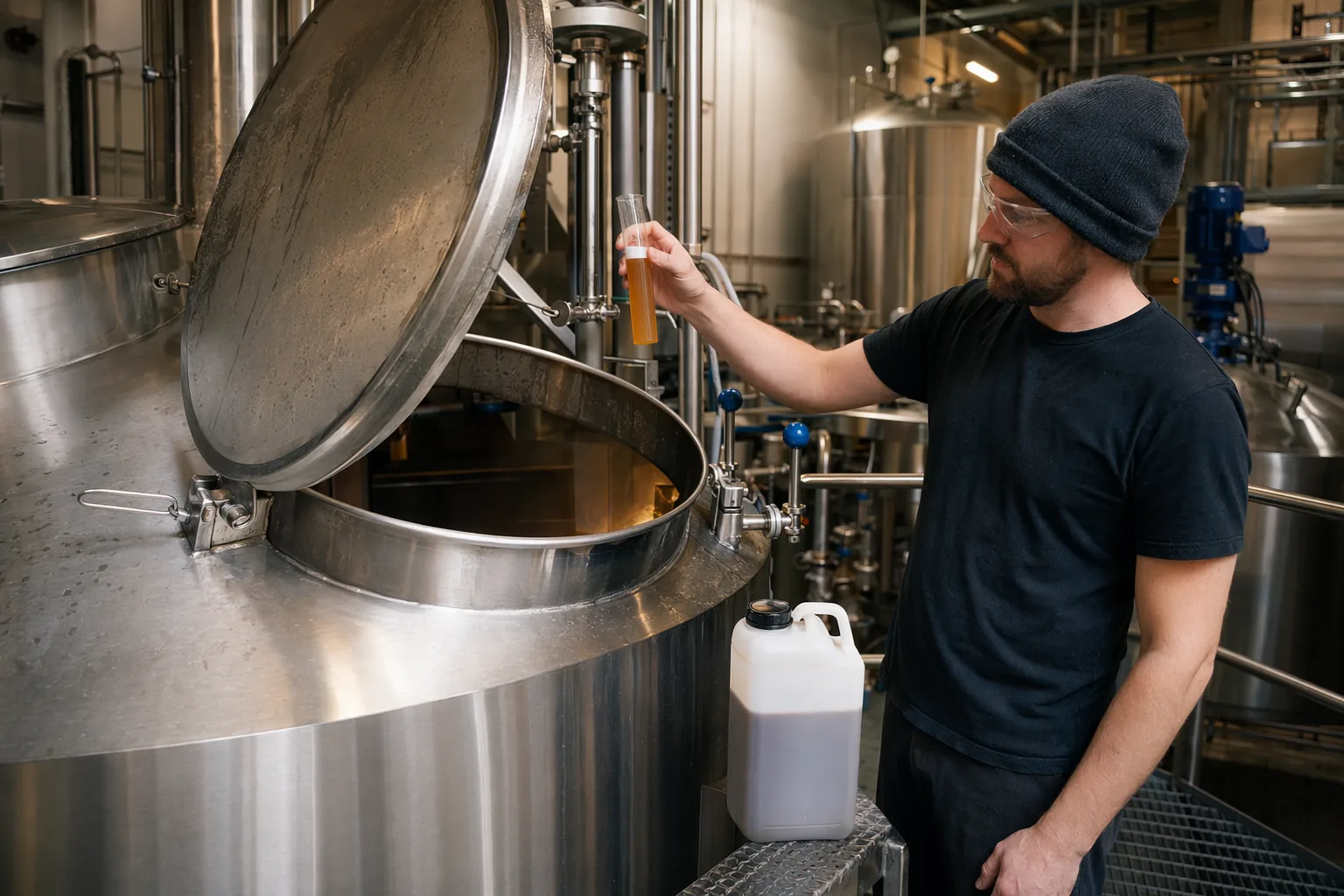
For breweries running rice, corn or other adjuncts, high-gravity mashes or tighter fermentability targets, supplemental starch-converting enzymes keep conversion consistent when malt alone cannot. This guide is written for production brewers, contract brewers and the distributors who supply them.
Supply is liquid or powder in 25 kg drums or 200 L barrels, minimum order 25 kg, quoted per order. To request a quote, send the product or application, the quantity and the destination through the inquiry form.
Where Amylase Fits in the Brewing Process
Amylase enzyme brewing applications focus on converting starch from malted barley, unmalted cereals, rice, corn, sorghum, wheat, or other adjuncts into soluble dextrins and fermentable sugars. In all-malt brewing, malt enzymes may be sufficient; however, commercial brewers often use supplemental amylase to manage variable raw materials, accelerate conversion, support high-gravity brewing, or improve extract yield. Alpha amylase breaks internal starch bonds and reduces mash viscosity, while glucoamylase can further convert dextrins to glucose for higher attenuation or dry beer profiles. Fungal alpha amylase enzyme brewing options are typically selected for lower-temperature mash programs or flavor-sensitive applications. The best enzyme choice depends on grist composition, gelatinization temperature, brewhouse residence time, wort fermentability target, and whether the enzyme should act in mash, cereal cooker, or fermentation.
Use alpha amylase for liquefaction and viscosity reduction. • Use glucoamylase when higher fermentability is required. • Use fungal alpha amylase where lower temperature activity is beneficial.
Selection Criteria for Brewing Buyers
For B2B purchasing, an amylase brewing enzyme should be evaluated as a processing aid with measurable cost-in-use, not only as a unit price per kilogram. Compare declared activity, recommended substrate, thermal profile, pH range, carrier system, physical form, shelf life, and lot-to-lot consistency. A supplier should provide a current technical data sheet, certificate of analysis, safety data sheet, storage guidance, and documentation needed for your internal quality system. Ask whether the product is intended for brewing, distilling, or general starch processing, because performance conditions can differ. For breweries producing multiple beer styles, prioritize enzymes with predictable dose response and clear inactivation behavior. Supplier qualification should also include lead time, packaging compatibility, technical support availability, and ability to support pilot validation before full production conversion.
Review COA, TDS, SDS, shelf life, and storage requirements. • Confirm activity units and application conditions before comparing quotes. • Evaluate cost per hectoliter or per metric ton of grist.
Process Windows: Start From the TDS, Confirm in a Pilot
Process conditions must follow the enzyme supplier's TDS, and the right window differs by enzyme type. Bacterial (thermostable) alpha-amylase is chosen for cereal cooking or adjunct liquefaction, where it has to survive high temperatures for the hold time. Fungal or malt-compatible amylase is screened at normal mash temperatures. Glucoamylase for fermentability is used in the mash or, when the product is designed for it, at fermentation temperature. Dose is best set on an activity basis: start at the supplier's recommended rate, track conversion, and increase only when extract, viscosity or attenuation targets are not met.
Do not assume one dosage fits all grists or brewhouses. • Confirm enzyme survival or inactivation at your actual process temperature. • Use activity-based dosing when comparing concentrated products.
How to Use Amylase Enzyme in Brewing
When planning how to use amylase enzyme in brewing, define the process objective first: faster starch conversion, lower viscosity, improved extract, higher apparent attenuation, or consistent adjunct performance. For mash applications, dilute liquid enzyme in clean brewing liquor and dose at mash-in or before the target temperature hold to support even distribution. In cereal cooking, dose once the slurry pH and temperature are within the enzyme’s working range. For high-attenuation beers, glucoamylase may be added during mash conversion or fermentation only if the product is intended for that stage. Avoid adding amylase into boiling wort unless the goal is intentional inactivation, because most enzymes will rapidly lose activity. Record lot number, dosage, temperature profile, pH, hold time, and wort analytics for every trial.
Dose into a well-mixed zone to prevent localized over-treatment. • Verify amylase enzyme brewing when to add through pilot trials. • Document each trial for repeatability and quality review.
Quality Control Checks During Validation
Pilot validation should compare treated and untreated brews under the same grist, water, mash profile, yeast, and fermentation conditions. Core brewhouse checks include mash pH, mash viscosity or lautering rate, iodine conversion, extract yield, wort gravity, fermentability, and kettle loading. Fermentation checks should include apparent attenuation, alcohol target, residual extract, pH drop, diacetyl management, and yeast performance. Finished beer review should include turbidity, foam, flavor, body, dryness, and shelf stability where relevant. For beer clarification enzyme programs, confirm that amylase use does not interfere with downstream clarification, filtration, or haze control strategy. The validation package should define acceptance criteria before trials begin, including maximum allowed flavor shift and minimum economic gain per batch.
Run side-by-side pilot or production split trials where possible. • Measure both technical performance and sensory impact. • Keep retained samples for stability comparison.
Scale-Up, Procurement, and Cost-in-Use
After pilot success, scale-up should account for mixing energy, dosing accuracy, hold time, tank geometry, and raw material variation. A product that performs well in a bench mash may require dosage adjustment in production if temperature ramps, pH drift, or adjunct hydration differ. Procurement teams should compare total cost-in-use: enzyme dose, extract gain, cycle time, filtration improvement, attenuation control, waste reduction, and risk of off-spec beer. Supplier qualification should include manufacturing consistency, documentation responsiveness, change notification practice, and technical troubleshooting support. Confirm storage temperature, freeze-thaw sensitivity, personal protective equipment from the SDS, and first-expiry-first-out inventory control. A well-managed amylase enzyme for brewing program should be reviewed periodically as malt crop, adjunct source, recipe, and brewhouse targets change.
Calculate cost per batch, hectoliter, or metric ton of grist. • Include operational gains, not only enzyme purchase price. • Revalidate when grist, process, or supplier lot changes materially.
Technical Buying Checklist
Buyer Questions
Alpha amylase randomly breaks internal starch bonds, reducing viscosity and forming soluble dextrins that support mash conversion and extract recovery. Glucoamylase works from non-reducing chain ends and can release glucose from dextrins, increasing fermentability and apparent attenuation. Many breweries use alpha amylase for liquefaction or mash conversion and glucoamylase only when a drier, higher-attenuation profile is required.
The addition point depends on the enzyme type and process goal. Alpha amylase is commonly added at mash-in, during a conversion rest, or in a cereal cooker when pH and temperature match the TDS. Glucoamylase may be added in mash or fermentation if designed for those conditions. Pilot trials should confirm the timing that delivers conversion without unwanted sensory or attenuation changes.
In most breweries, amylase supplements malt enzyme activity rather than replacing malt functionality completely. Malt contributes flavor, color, proteins, FAN, buffering, and natural enzyme systems. Supplemental amylase can help when adjunct levels are high, malt quality varies, or the process requires faster conversion. Formulations with very low malt content need broader process design and additional quality checks beyond amylase alone.
Request a technical data sheet for application conditions, a certificate of analysis for lot-specific quality attributes, and a safety data sheet for handling controls. Buyers should also ask for shelf life, storage conditions, lot traceability, allergen or carrier information, packaging details, and change notification practice. These documents support supplier qualification, internal QA review, and consistent production use.
Start with bench or pilot mashes using representative grist, water, pH, and temperature profiles. Compare untreated and treated trials for iodine conversion, extract, viscosity, wort gravity, fermentability, attenuation, turbidity, and sensory results. If the pilot meets acceptance criteria, run a controlled production trial with documented dosage, lot number, process conditions, and finished beer review before routine purchasing.
Brewing & Winemaking Enzymes for Research & Industry
Need Brewing & Winemaking Enzymes for your lab or production process?
ISO 9001 certified · Food-grade & research-grade · Ships to 80+ countries
Frequently Asked Questions
What is the difference between alpha amylase and glucoamylase in brewing?
Alpha amylase randomly breaks internal starch bonds, reducing viscosity and forming soluble dextrins that support mash conversion and extract recovery. Glucoamylase works from non-reducing chain ends and can release glucose from dextrins, increasing fermentability and apparent attenuation. Many breweries use alpha amylase for liquefaction or mash conversion and glucoamylase only when a drier, higher-attenuation profile is required.
How do you decide amylase enzyme brewing when to add?
The addition point depends on the enzyme type and process goal. Alpha amylase is commonly added at mash-in, during a conversion rest, or in a cereal cooker when pH and temperature match the TDS. Glucoamylase may be added in mash or fermentation if designed for those conditions. Pilot trials should confirm the timing that delivers conversion without unwanted sensory or attenuation changes.
Can amylase replace malt enzymes completely?
In most breweries, amylase supplements malt enzyme activity rather than replacing malt functionality completely. Malt contributes flavor, color, proteins, FAN, buffering, and natural enzyme systems. Supplemental amylase can help when adjunct levels are high, malt quality varies, or the process requires faster conversion. Formulations with very low malt content need broader process design and additional quality checks beyond amylase alone.
What documents should an industrial buyer request from an enzyme supplier?
Request a technical data sheet for application conditions, a certificate of analysis for lot-specific quality attributes, and a safety data sheet for handling controls. Buyers should also ask for shelf life, storage conditions, lot traceability, allergen or carrier information, packaging details, and change notification practice. These documents support supplier qualification, internal QA review, and consistent production use.
How should a brewery validate amylase enzyme for brewing at plant scale?
Start with bench or pilot mashes using representative grist, water, pH, and temperature profiles. Compare untreated and treated trials for iodine conversion, extract, viscosity, wort gravity, fermentability, attenuation, turbidity, and sensory results. If the pilot meets acceptance criteria, run a controlled production trial with documented dosage, lot number, process conditions, and finished beer review before routine purchasing.
How should breweries compare enzyme supplier quotations?
Compare quotations by cost-in-use, not only unit price. Include enzyme activity, expected dosage, freight, packaging, storage stability, shelf life, trial support, and consistency between lots. A higher-priced product may be more economical if it reduces dosage, improves extract, shortens processing time, or delivers more predictable attenuation. Always confirm assumptions with pilot validation under brewery conditions.
What is an amylase brewing enzyme used for?
An amylase brewing enzyme is used to break starch and dextrins into smaller carbohydrates during brewing. Depending on the enzyme type, it can support liquefaction, improve extract recovery, reduce wort viscosity, increase fermentability, or help manage high-adjunct recipes. Industrial brewers typically evaluate it against targets such as original gravity, attenuation, filtration speed, final gravity, and finished-beer profile.
Related: Brewing enzymes market solutions for clearer, faster production
Turn This Guide Into a Supplier Brief Request a brewing enzyme consultation, sample, COA, TDS, and SDS for pilot validation in your brewhouse. See our application page for Brewing enzymes market solutions for clearer, faster production at /applications/brewing-enzymes-market/ for specs, MOQ, and a free 50 g sample.
Contact Us to Contributehello@mail.clearenzyme.com