Brewing Enzymes Market: Brewing & Winemaking Enzymes Supplier Guide — Supplier Guide
B2B guide to brewing enzymes market trends, selection, dosing, QC, COA/TDS/SDS review, pilot validation, and supplier qualification.
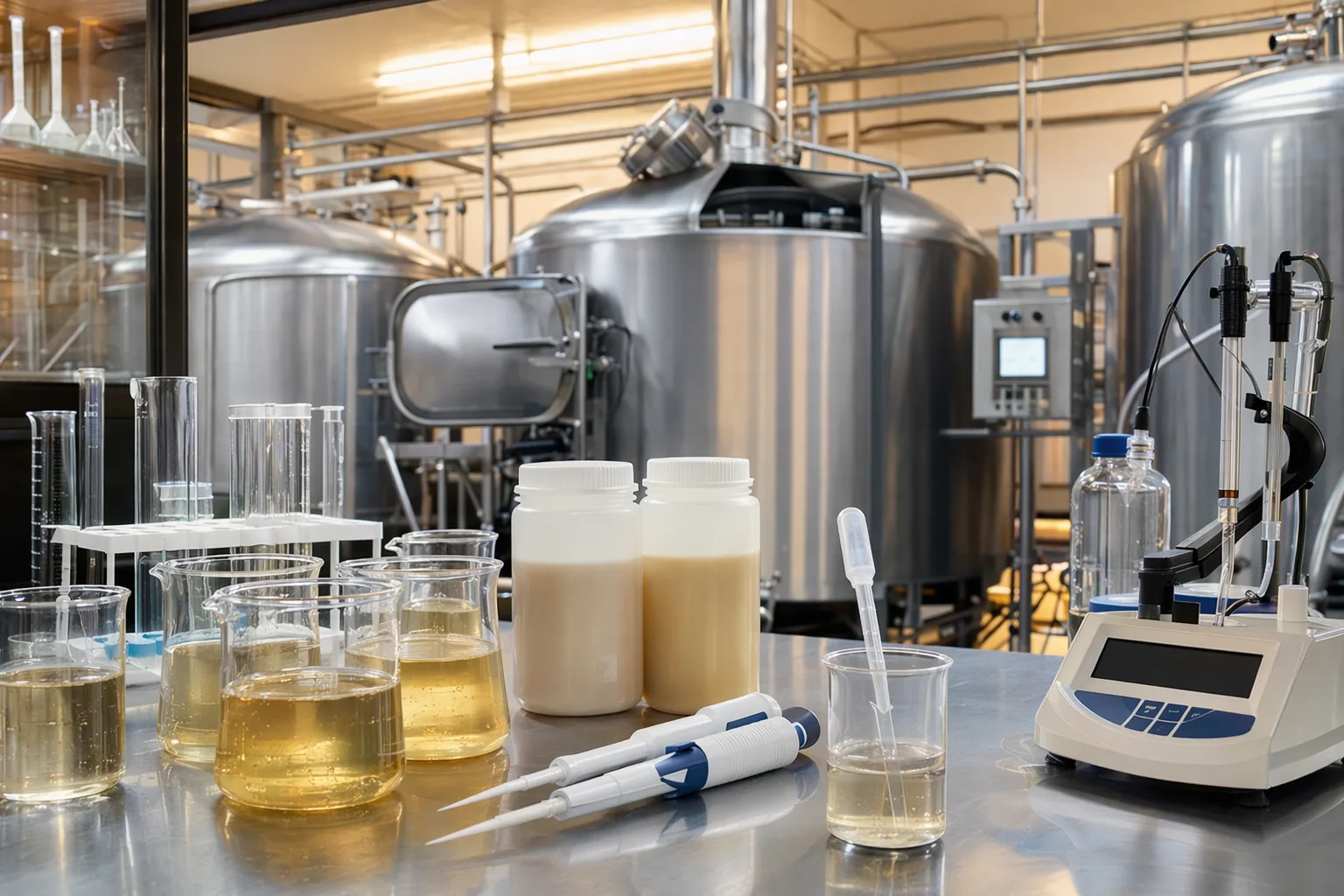
For breweries, wineries, and distillers, enzyme selection is a cost-in-use decision tied to extract yield, filtration speed, clarification, attenuation, and batch consistency.
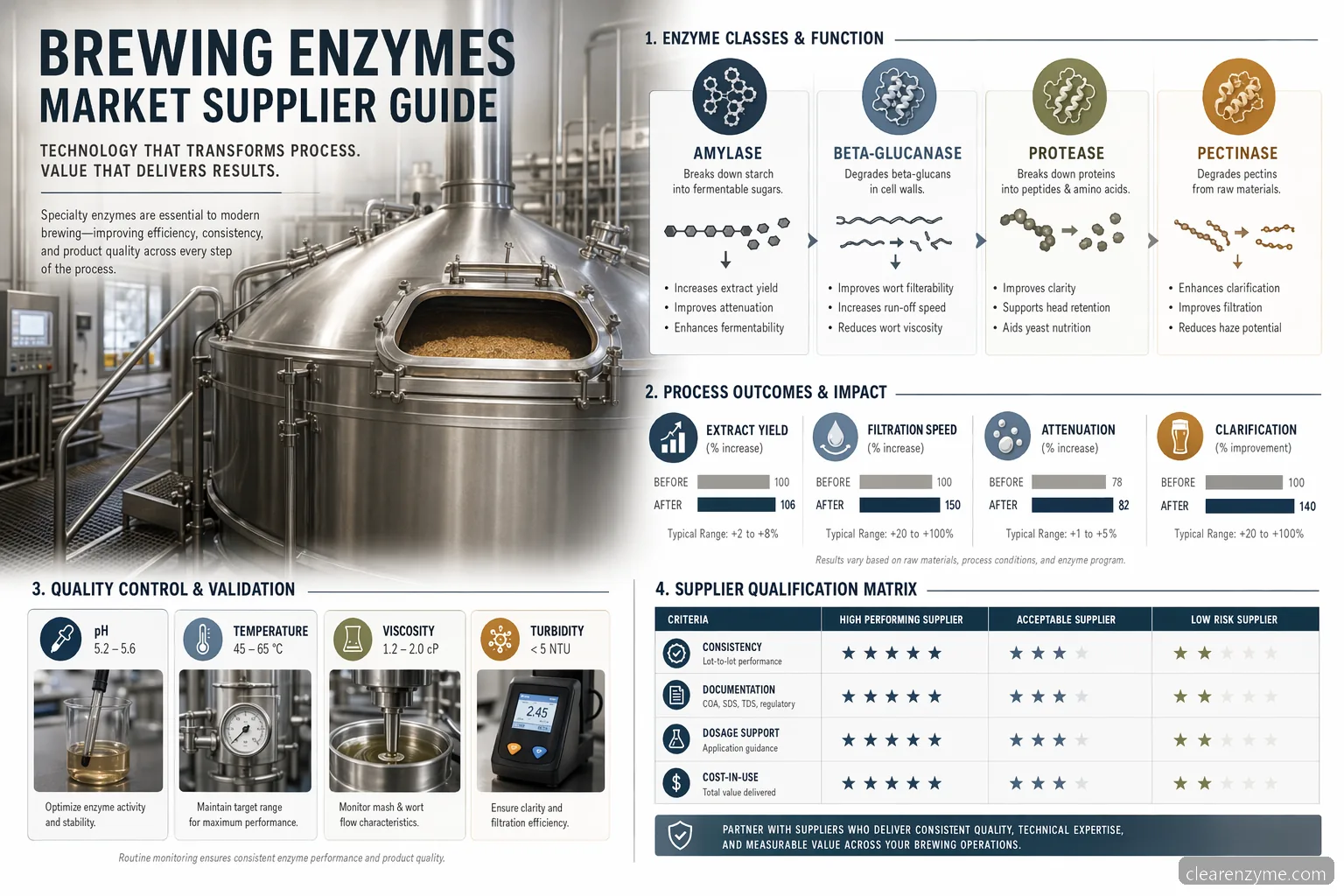
Market context for industrial brewing enzyme buyers
The brewing enzymes market serves commercial brewers that need predictable conversion, faster separation, improved clarification, and better use of adjuncts such as rice, corn, sorghum, wheat, or unmalted barley. In buyer discussions, brewing enzymes market size, brewing enzymes market revenue, and brewing enzymes market share are useful indicators of supply depth, but they should not replace technical validation. The global brewing enzymes market includes amylases, glucoamylase, proteases, beta-glucanases, xylanases, cellulases, and clarification enzymes used across mashing, fermentation support, filtration, and stabilization. Regional demand differs: the US brewing enzymes market often emphasizes craft consistency and high-gravity brewing, while the African brewing enzymes market may focus on local grains, cost control, and variable raw material quality. A practical brewing enzymes market analysis should connect market trends to plant-level performance, not just procurement price.
Prioritize enzymes that match your malt, adjunct, equipment, and beer style. • Compare delivered cost with extract gain, filtration savings, and reduced rework. • Request current technical documentation before production trials.
Core enzyme types used in brewing applications
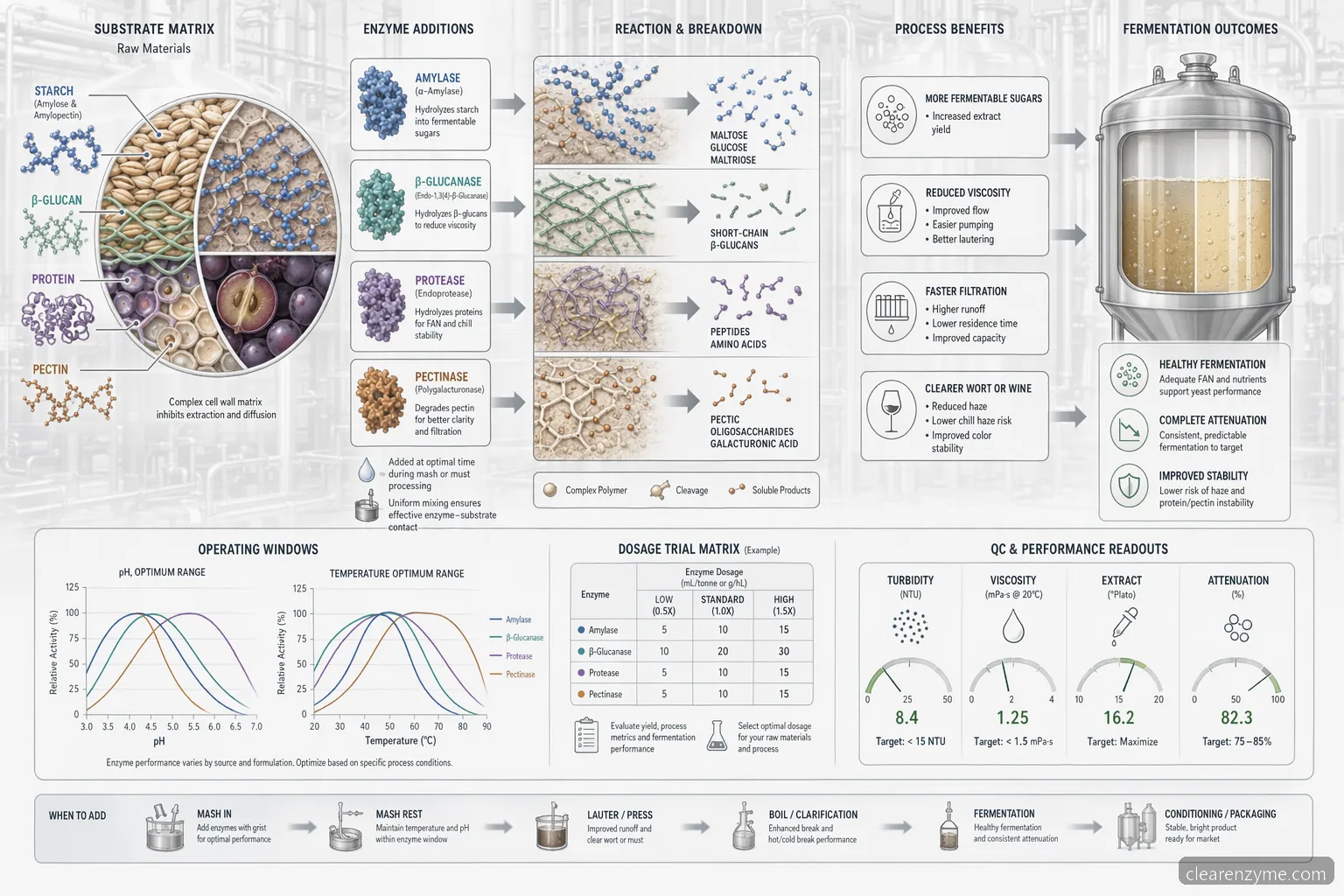
Brewing enzymes are selected by unit operation and target substrate. Alpha-amylase reduces starch viscosity and supports liquefaction, typically working in mash conditions near pH 5.2-6.0 and 70-90°C depending on product design. Glucoamylase brewing applications convert dextrins into fermentable glucose, often used around pH 4.0-5.5 and 55-65°C in mashing or lower temperatures during extended conversion where the product is suitable. Beta-glucanase helps break beta-glucans from barley, wheat, rye, or oats, improving lautering and filtration; common process windows are pH 4.5-5.5 and 40-60°C. Proteases can support FAN development and haze management, but overuse may affect foam stability. Beer clarification enzyme options, including protease or pectinase-type systems where appropriate, should be validated for turbidity reduction, sediment behavior, and sensory neutrality.
Alpha-amylase: starch thinning and liquefaction support. • Glucoamylase: higher fermentability and attenuation control. • Beta-glucanase: lower viscosity and improved filtration. • Protease: protein modification, FAN support, and clarification control.
Process conditions, dosage bands, and trial design
Safe starting dosage bands vary by enzyme activity, substrate load, and process time, so suppliers should provide TDS guidance in activity units rather than vague volume measures. As a screening approach, liquid alpha-amylase may be trialed in low ppm-to-hundreds ppm ranges relative to grist or mash, while beta-glucanase and protease products are often evaluated at lower targeted rates. Glucoamylase brewing trials should define whether the target is dry beer, high attenuation, low residual dextrin, or improved yield in distilling wash. Hold pH, temperature, calcium level, mash thickness, and contact time constant during A/B trials. Include untreated control and at least two dosage levels. Avoid extrapolating from one recipe to all products because dark malts, adjunct ratio, and filtration media can change enzyme response.
Run a control, low dose, and supplier-recommended dose. • Measure extract, fermentability, viscosity, turbidity, and filtration rate. • Document pH, temperature, contact time, and adjunct percentage. • Scale up only after sensory and analytical checks are acceptable.
Quality control checks for brewery validation
QC should confirm that an enzyme improves the intended metric without creating downstream risk. For mashing enzymes, track original extract, apparent attenuation limit, iodine conversion, viscosity, lautering time, and spent grain moisture. For beer clarification enzyme trials, monitor haze by turbidity, chill haze formation, sediment compaction, filter differential pressure, and packaged beer stability. Fermentation checks should include gravity curve, pH, yeast performance, diacetyl management, and sensory screening. Industrial buyers should request a COA for each lot, a TDS with activity definition and use conditions, and an SDS for handling and storage. If the supplier changes formulation, production site, carrier, preservative system, or activity standardization method, the brewery should assess whether revalidation is needed before routine production use.
Require lot-specific COA review before receipt or release. • Keep retain samples for dispute investigation. • Use sensory panels to detect unintended flavor or mouthfeel shifts. • Link QC data to cost-in-use, not dosage alone.
Supplier qualification and procurement criteria
A strong supplier evaluation looks beyond catalog availability. Ask whether the supplier can support pilot validation, dosage optimization, troubleshooting, and documentation requests for COA, TDS, SDS, allergen statements when relevant, and change notification. Review lead time, minimum order quantity, shelf life, recommended storage, packaging compatibility, and shipping conditions. Confirm whether the supplier can provide consistent activity across lots and explain the analytical method used for activity declaration. Commercially, compare price per kilogram or liter with activity concentration, expected dose, yield impact, filtration time reduction, and batch risk reduction. The best fit in the brewing enzymes market is usually the supplier that can demonstrate stable technical support and measurable cost-in-use improvement under your actual brewing conditions.
Request samples for bench and pilot trials. • Evaluate technical responsiveness during the trial, not only after purchase. • Compare activity-normalized cost rather than package price. • Confirm documentation and change-control expectations in writing.
Brewing enzymes market trends affecting buying decisions
Current brewing enzymes market trends are shaped by raw material volatility, high-gravity brewing, low-alcohol and no-alcohol product development, faster clarification targets, and demand for consistent output across distributed production sites. The global brewing enzymes market is also influenced by breweries seeking local grain utilization, including sorghum, cassava, maize, and other adjuncts that require more deliberate enzyme programs. In the US brewing enzymes market, craft and regional brewers often look for flexible enzymes that can solve hazy filtration, stuck mash, or attenuation variation without changing brand character. In the African brewing enzymes market, practical buying criteria may include performance with local grains, robust logistics, and cost-in-use under variable raw material quality. Buyers should turn these trends into test plans, specifications, and supplier scorecards.
Use market insight to shortlist enzyme classes, not to skip trials. • Validate regional raw materials under local water and mash conditions. • Reassess enzymes when recipes, adjuncts, or equipment change.
Technical Buying Checklist
Buyer Questions
Start with the process problem: low extract, slow lautering, high viscosity, poor attenuation, haze, or filtration bottlenecks. Then match the substrate to the enzyme class and request COA, TDS, and SDS documents. Run bench or pilot trials under your actual pH, temperature, grist, adjunct level, and contact time. Choose the supplier that delivers measurable cost-in-use improvement and reliable technical support.
Glucoamylase brewing enzymes hydrolyze dextrins into fermentable glucose, supporting higher attenuation, drier beer profiles, and efficient fermentable extract generation. They are also relevant in distilling washes where fermentability is a key yield driver. Dosage and timing should be validated carefully because over-conversion can change body, sweetness, alcohol level, and brand character. Always confirm performance through gravity, attenuation, and sensory checks.
A beer clarification enzyme may reduce haze-forming proteins or other substrates and can improve filtration performance, but it should not be treated as a universal replacement for sound process control. Validate it against turbidity, chill haze, sediment, filter pressure, package stability, and sensory impact. If the root cause is yeast handling, raw material variation, or poor separation, enzyme use should be combined with process correction.
Request a lot-specific COA, product TDS, SDS, storage and shelf-life guidance, activity definition, recommended dosage range, and handling instructions. For recurring supply, also clarify packaging, lead time, minimum order quantity, change notification, and support for pilot validation. These documents help procurement, QA, production, and EHS teams evaluate suitability before the enzyme enters routine brewery use.
Brewing enzymes market trends can highlight demand for high-gravity brewing, adjunct flexibility, faster clarification, and low- or no-alcohol production. However, procurement should translate trends into measurable technical requirements. The right purchasing decision depends on your recipes, raw materials, equipment, QC targets, and cost-in-use. Market share or revenue data may inform supplier shortlisting, but plant-level validation should decide adoption.
Brewing & Winemaking Enzymes for Research & Industry
Need Brewing & Winemaking Enzymes for your lab or production process?
ISO 9001 certified · Food-grade & research-grade · Ships to 80+ countries
Frequently Asked Questions
How should a brewery choose enzymes from the brewing enzymes market?
Start with the process problem: low extract, slow lautering, high viscosity, poor attenuation, haze, or filtration bottlenecks. Then match the substrate to the enzyme class and request COA, TDS, and SDS documents. Run bench or pilot trials under your actual pH, temperature, grist, adjunct level, and contact time. Choose the supplier that delivers measurable cost-in-use improvement and reliable technical support.
What is the role of glucoamylase brewing enzymes?
Glucoamylase brewing enzymes hydrolyze dextrins into fermentable glucose, supporting higher attenuation, drier beer profiles, and efficient fermentable extract generation. They are also relevant in distilling washes where fermentability is a key yield driver. Dosage and timing should be validated carefully because over-conversion can change body, sweetness, alcohol level, and brand character. Always confirm performance through gravity, attenuation, and sensory checks.
Can a beer clarification enzyme replace filtration changes?
A beer clarification enzyme may reduce haze-forming proteins or other substrates and can improve filtration performance, but it should not be treated as a universal replacement for sound process control. Validate it against turbidity, chill haze, sediment, filter pressure, package stability, and sensory impact. If the root cause is yeast handling, raw material variation, or poor separation, enzyme use should be combined with process correction.
What documents should industrial buyers request before ordering?
Request a lot-specific COA, product TDS, SDS, storage and shelf-life guidance, activity definition, recommended dosage range, and handling instructions. For recurring supply, also clarify packaging, lead time, minimum order quantity, change notification, and support for pilot validation. These documents help procurement, QA, production, and EHS teams evaluate suitability before the enzyme enters routine brewery use.
How do brewing enzymes market trends affect procurement?
Brewing enzymes market trends can highlight demand for high-gravity brewing, adjunct flexibility, faster clarification, and low- or no-alcohol production. However, procurement should translate trends into measurable technical requirements. The right purchasing decision depends on your recipes, raw materials, equipment, QC targets, and cost-in-use. Market share or revenue data may inform supplier shortlisting, but plant-level validation should decide adoption.
Related: Brewing enzymes market solutions for clearer, faster production
Turn This Guide Into a Supplier Brief Request brewing enzyme samples, COA/TDS/SDS review, and a pilot validation plan from Clear Enzyme. See our application page for Brewing enzymes market solutions for clearer, faster production at /applications/brewing-enzymes-market/ for specs, MOQ, and a free 50 g sample.
Contact Us to Contribute